
Metabolic Dysfunction
What it actually is, and what the evidence says about reversing it

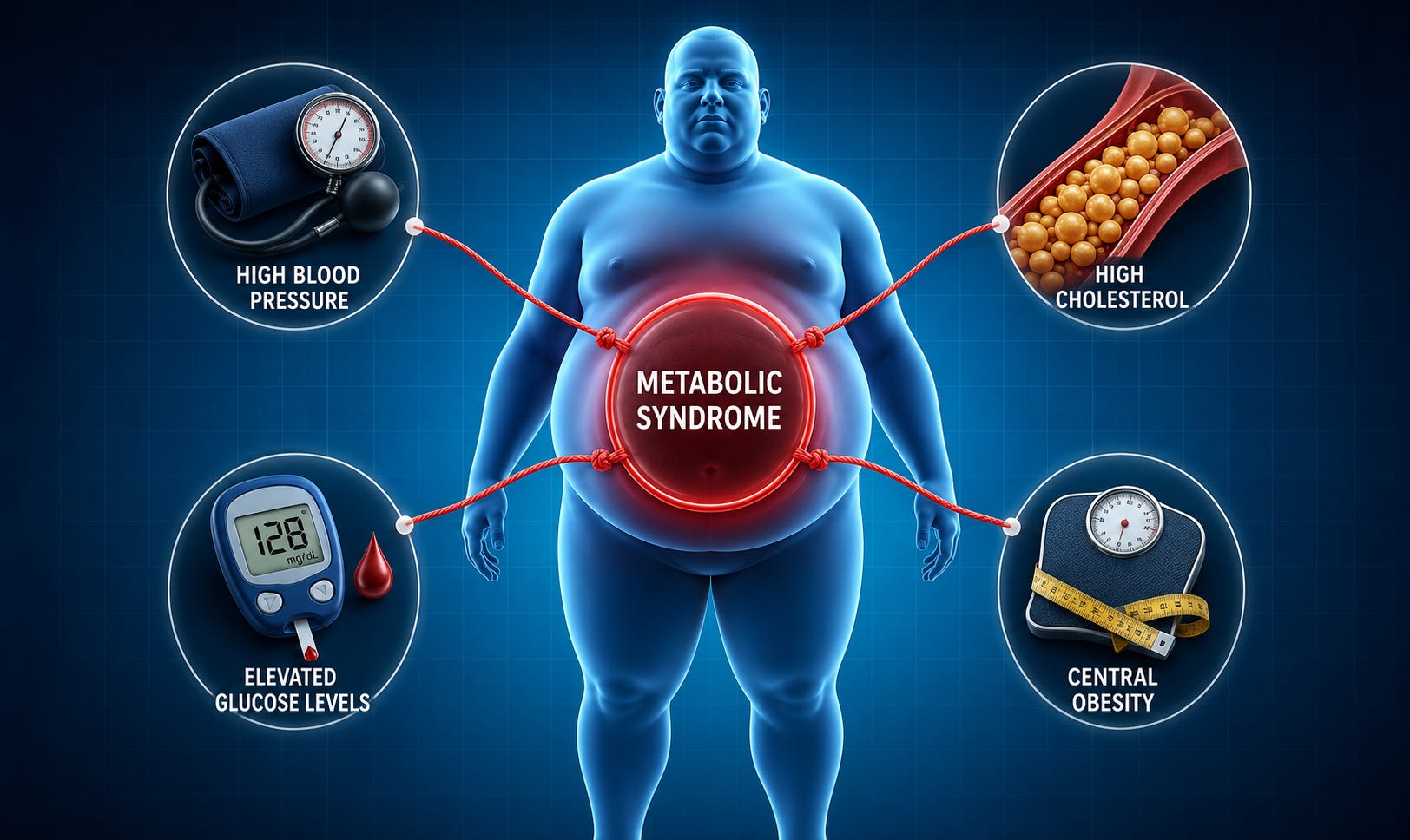
Metabolic dysfunction gets thrown around a lot right now, in supplement marketing, in biohacking podcasts, in wellness content that promises to “fix your metabolism” with a powder or a tonic. That looseness is a problem because underneath the buzzword sits something real, well-studied, and genuinely common.
This piece tries to separate the two: what metabolic dysfunction actually is, what’s known about the causes and what the evidence actually supports for reversing it.
Background: how big is this, really?
Metabolic Syndrome is the medical term most closely tied to what people mean by “metabolic dysfunction.” It’s not one disease, it’s a cluster of problems that tend to show up together. Extra fat around the belly, high blood pressure, high blood sugar, and an unhealthy mix of blood fats (high triglycerides, low “good” HDL cholesterol). Roughly 3 in 10 adults worldwide have this cluster.
The idea has a real history.
Back in 1988, a researcher named Gerald Reaven1 gave an influential lecture arguing that one single problem sits underneath this whole grouping - your cells becoming resistant to insulin, the hormone that manages blood sugar.
That idea eventually became a standard tool doctors use to flag people at higher risk of heart disease and diabetes, and in 2009 an international group of experts agreed on the specific measurements used to diagnose it - waist size, triglycerides, HDL cholesterol, blood pressure, and blood sugar2.
You’ll also see related terms floating around this topic, insulin resistance, prediabetes, and fatty liver disease (now officially called MAFLD, previously known as NAFLD)3. These aren’t separate problems so much as different pieces of the same underlying picture. Fatty liver disease alone is estimated to affect around 1.27 billion people globally4 5.
What it actually is, in plain terms
At the centre of nearly all of this is insulin resistance. Here’s the simple version. Insulin is the hormone your pancreas releases to tell your muscles, liver and fat cells to take sugar out of your bloodstream and use or store it. When those tissues stop listening to insulin properly, your pancreas compensates by pumping out more and more of it. That works for a while, until it doesn’t.
Over time, insulin resistance is linked to high blood sugar, high blood pressure, unhealthy cholesterol levels, extra fat stored around the organs, low-level inflammation throughout the body and damage to the lining of blood vessels. Left unchecked, it’s associated with the development of type 2 diabetes, obesity, heart disease, and fatty liver disease.
Researchers believe a big part of the problem is fat ending up stored in the wrong places, inside the liver and inside muscle tissue, rather than in normal fat stores under the skin, combined with low-grade inflammation that interferes with how insulin signals work6. It’s worth noting here, even the scientists studying this admit the precise mechanism isn’t fully worked out, even though the resulting health effects are very well documented.
Body fat itself isn’t just passive padding, it acts more like a hormone-producing organ, sending out signals that affect the rest of the body. When fat tissue becomes insulin resistant, those signals go haywire, which affects the whole body. It works both ways too. Insulin resistance in fat tissue helps drive the broader problem, and the inflammation that comes with the broader problem then makes the fat tissue even less sensitive to insulin. It’s a bit of a vicious circle.
There’s also growing interest in how this connects to brain health7. Scientists have proposed links between insulin resistance and conditions like Alzheimer’s and Parkinson’s, possibly through shared problems in how cells produce energy. This is genuinely still being researched, though, not a settled fact so it shouldn’t be read as “metabolic dysfunction causes dementia.” The link is an association scientists are still trying to understand, not a proven cause-and-effect.
Root causes: what the evidence actually points to
Ultra-processed food:
A 2023 review pulling together multiple studies found that people who eat more ultra-processed food - think packaged snacks, fast food, sugary drinks, most ready meals - have a higher risk of metabolic syndrome8 9. The link showed up more clearly in snapshot studies than in studies following the same people over many years, which is worth flagging, since long-term studies are usually better at showing what actually causes what.
The proposed reasons go beyond just calories or sugar. Certain additives common in these foods, including emulsifiers (used to stop ingredients separating) and artificial sweeteners, have been shown in both animal and human studies to change the mix of bacteria living in your gut, in ways linked to poorer blood sugar control.
Sugary drinks:
These have their own solid body of evidence. A large review pulling together 16 separate analyses of long-term studies found consistent evidence that drinking sugar-sweetened beverages raises the risk of metabolic syndrome and its individual parts of obesity, diabetes, and high blood pressure10.
Poor sleep and irregular sleep timing:
This is one of the strongest and probably most underrated pieces of the puzzle. Controlled studies have repeatedly shown that even a single night of reduced sleep makes healthy people measurably more insulin resistant the next day because the liver starts releasing more sugar into the blood than it should.
Longer studies back this up. Cutting down sleep to around six hours or less a night for six weeks caused double-digit percentage increases in insulin resistance in a group of women studied, with the effect hitting women past menopause even harder than younger women11.
Irregular sleep timing - shift work, jet lag, staying up late inconsistently - seems to make things worse on top of simply not sleeping enough by throwing your body’s internal clock out of sync with itself12.
Not moving enough:
This matters too, mostly because physical activity is one of the main things that protects against insulin resistance in the first place but more on that below, since most of the direct evidence here comes from studying what happens when people start exercising, not from studying inactivity on its own.
What actually reverses it - the evidence on treatment
This is the part where wording matters most. In proper research, “reversal” usually means a measurable improvement in specific numbers i.e. blood sugar, long-term blood sugar average (HbA1c), blood pressure, waist size or someone no longer meeting the medical definition of diabetes. It doesn’t mean a vague feeling of having “healed your metabolism.”
Losing a significant amount of weight is, by far, the best-proven approach:
A well-known UK study called DiRECT13 put people recently diagnosed with type 2 diabetes on a strict low-calorie diet (using meal-replacement shakes and soups, around 850 calories a day) for three to five months, then gradually reintroduced normal food.
After one year, 46% of people in this group no longer had diabetes by medical criteria, compared to just 4% in the group that received standard care. The more weight people lost, the more likely they were to see their diabetes go into remission, losing 10% of body weight was linked to remission rates above 70%.
A five-year follow-up found that among people who kept off more than 10kg of weight after two years, 81% were still in remission which tells you that keeping the weight off matters just as much as losing it in the first place. Similar results (roughly 47–60%+ remission) have shown up in other countries and populations using different versions of this calorie-restriction approach.
Exercise, especially strength/resistance training, helps even without major weight loss:
A 2025 review pulling together 50 separate trials (over 2,000 people with type 2 diabetes) found that resistance training - think weightlifting or bodyweight exercises - significantly improved blood sugar, blood fat levels, blood pressure, and waist size14.
Combining strength training with cardio (walking, cycling, etc.) seems to work better than either one alone in several studies, though how much someone benefits seems to depend on their starting point. People who are already overweight or insulin resistant seem to respond differently than people who are otherwise healthy doing the same exercise routine.
Getting more sleep:
This has real experimental support too, though it’s a newer and smaller body of research than diet or exercise studies: one study had chronically under-slept adults extend their sleep for two weeks and found this could improve blood sugar handling, logically following on from the finding that losing sleep harms it. Worth noting this evidence base is thinner than the weight-loss and exercise research15.
Time-restricted eating:
Eating only within a set daily window, a form of intermittent fasting has the newest solid research behind it.
A well-designed trial called TIMET16, published in 2024, tested an 8–10 hour daily eating window against standard nutrition advice alone, in 108 adults with metabolic syndrome. Importantly this was on top of whatever medication and treatment people were already using, not instead of it.
Separately, another trial comparing intermittent fasting against simply eating fewer calories every day found both approaches produced similar improvements in blood pressure, cholesterol, blood sugar, and insulin, suggesting the fasting schedule itself may matter less than the resulting calorie reduction and weight loss.
That’s an important nuance that tends to get lost in fasting marketing, where the eating schedule is sometimes presented as doing something calorie-counting alone supposedly can’t.
The bottom line:
Metabolic dysfunction is real, well understood by science, and extremely common, it’s not something the wellness industry invented to sell you something.
But the things that actually reverse it, according to the evidence, are refreshingly unglamorous such as:-
losing a meaningful amount of weight (through whichever approach you can actually stick to),
strength and combined exercise,
getting enough sleep at consistent times, and
cutting back on ultra-processed food and sugary drinks.
Scientists increasingly understand how these things connect to insulin resistance under the hood, even where some of the finer detail is still being worked out.
This piece covers population-level evidence and is not individual medical advice. If you’re managing diabetes, prediabetes, or metabolic syndrome, work with your own clinician on any dietary or exercise changes - particularly around medication adjustments, which in trials like DiRECT were done under close medical supervision.
Reaven, G. Banting Lecture 1988 — insulin resistance and metabolic syndrome (Springer Nature summary)
Rabiee, A. et al. (2025). Adipose Tissue Insulin Resistance: A Key Driver of Metabolic Syndrome Pathogenesis. Biomedicines. DOI: 10.3390/biomedicines13102376
Lean, M.E.J. et al. DiRECT trial (Lancet) and 5-year extension (Lancet Diabetes & Endocrinology, 2024)
https://www.thelancet.com/journals/landia/article/PIIS2213-8587%2823%2900385-6/fulltext
Wilkinson, M.J. et al. TIMET trial. Annals of Internal Medicine (2024). DOI: 10.7326/M24-0859